Lets Dance

I have always danced in my life, in some form or other, sometimes with more enthusiasm ( lacking natural coordination) than skill but always with enjoyment. Ballet and Ballroom Dancing as a child. Practising my dance moves at home for the school disco, then moving on to Ska, Northern Soul and New age. ( Post-Punk) Now my clubbing days are over, I still dance at the odd wedding and like to dance in my kitchen. (luckily the flat below is very understanding ) Dance is supposed to connect you to your inner child, certainly it makes me feel like a teenager. Particularly when I listen to certain tracks which bring up feelings of nostalgia. 

Many of us have signed up for classes at the local gym, dance school or even virtually. Shows like Come Dancing encourage us to have a go. Babies and small children always move to music, it’s something that comes naturally. As adults many of us think we can’t dance, as we are uncoordinated or lacking a sense of rhythm, but it really doesn’t matter and if fear of judgement from others is released it can be lots of fun. Even professional dancers make mistakes. They use them to learn and improve themselves and so should you.

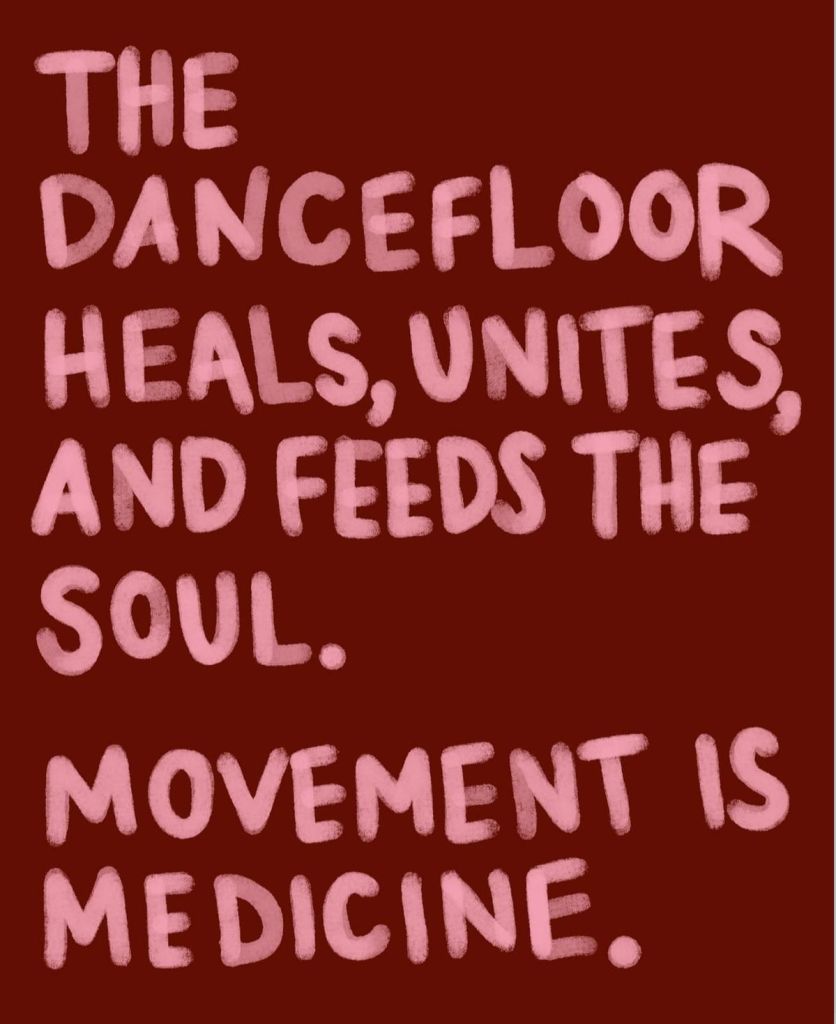
So, what is it that makes dance so special?

Research has found that dance of any genre is equal and occasionally more effective than other types of physical activity for improving psychological and cognitive outcomes.“Most people know that physical activity is beneficial for health compared to doing nothing, but they may not realise that dance can be an effective alternative to standard exercise like running, going to the gym, and other sports.”

Releasing energy through movement can help us let go of stress. There’s a wide range of benefits to your body, a workout to stay toned and flexible, increasing stamina and offering a fun way of getting and staying fit. It also keeps your mind sharp and can improve mental health and boost well being.  What makes this work so well, is listening to music which triggers our brains reward centre and movement which brings on endorphins, making you feel happy. Its fairly impossible to be miserable whilst dancing. 

As we age, it gets harder to remember names, places, and other details. Learning new things, like different moves and styles of dance, sharpens your brain’s ability to remember these kinds of details. When done regularly it can improve the brain’s function and prevent Dementia.

Dance has been a part our culture for tens of thousands of years. Archaeological evidence and cave paintings confirm it existed as a form of human expression and communication long before the invention of written language. Early dances been ritualist in nature. The Ancient Greeks were to integrate structured dance into their theatre as well as religious ceremonies. Dance evolved into theatrical and social forms. The folk dances of the Middle Ages turned into formal Ballroom dancing .These dances moved into royal courts beginning to become popular as dancing masters taught upper classes the proper steps for court dances. Ballet too originated in the 15th-century Italian Renaissance courts. In the nineteenth century, women’s clothing allowed more freedom of movement and dancing was to become more lively. The Waltz was a major dance craze as social dances began to focus on two-person dancing moving into the twentieth century.

Many people carry the customs of their homelands through folk dancing and accompany these dances with the music of their culture. Street dancing in Spain blends traditional folk dances with Flamenco. The Sardana. Is an open-circle, communal street dance where locals join hands in the streets and town squares. I witnessed this in Barcelona and it was wonderful to see all generations taking part.

There are various dances available to try some more physical than others, depending on your current fitness level, Ballroom, which is great for all ages and levels and is a great way to meet other people socially. Adult ballet and cardio ballet/ Barre workouts are widely available. Zumba, there is no right or wrong way. Salsa, boosts co-ordination and don’t we all love Bad Bunny at the moment. Line dancing, my sister who isn’t very active loves this and any activity wearing Cowboy boots is a good one. Hip-Hop and street dance if you want to try something more high impact. There’s a newish trend for breakfast discos/ raves nationwide for anyone who doesn’t want to go to the gym. Definitely a mood boosting way to start the day.

Health clubs, community centres and Dance schools/ studios offer dance classes and if you want to practise to gain confidence before joining a class, YouTube has many great options.

Why not have a go, and in the words of the legendary David Bowie Lets Dance…..
Bill of Rights- Anne Dickson

I found this whilst looking through some old files, this was a previous blog I posted years ago. And it seems as relevant today as it was then.

Many of us, in particular, women feel that our personal rights and needs are less important than those of others. And that if we were to be more assertive with our rights that it would make us appear selfish. But this really isn’t the case. We all have a right to be heard and to be able to express what we think and want and require from others. Conflict isn’t welcomed by everyone and many of us try our best to avoid it. Instead of speaking up, we keep quiet. We smile, pretend to agree, play along, or turn a deaf ear. Over time we allow ourselves to be reduced to being mere bystanders- both in our immediate environment and in the world at large. 

In her pioneering handbook, A Woman in Her Own Right,  written in 1982,  Anne Dickson draws on her long experience of in-person training to give women the tools needed to assert what they feel and want, manage difficult conversations and avoid being sidetracked by culturally learned behaviours. The assertiveness techniques were eagerly grasped by women who experienced inequalities at the time. Like unequal pay or exclusion from certain professions or high-levels management positions and who were ready for change. This struck a chord, both here and abroad, and many women went on to transform their lives in various ways. 

It’s not about not caring about other people or hurting them, as often we care more about others than we do for ourselves. It can feel quite hard to put this into practice at first. I was talking recently to a new neighbour, who in conversation started to tell me that my opinion was wrong about the topic we were discussing. I politely said that I was entitled to my opinion as I have a right to think differently to them. If this didn’t go down well, it doesn’t matter one bit, as I have the right to express my feelings, opinions and values, as do you. Assertive personal power means saying ‘no’ clearly when that’s what you want to say, it means expressing your needs and challenging an unfair criticism, it means initiating a difficult conversation with someone you care about at times.

There are 11 basic rights  given in this book, I have listed a few of these below:

  1. I have the right to express my feelings,opinions and values
  2. I have the right to be me
  3. I have the right to say no
  4. I have the right to make mistakes
  5. I have the right to change my mind
  6. I have the right to say that I don’t understand
  7. I have the right to not feel responsible for the problems of other adults
  8. I have the right to put myself first
  9. I have the right to not be dependent on the approval of others

Anne Dickson is a psychologist, counsellor, trainer and writer with over 40 years’ experience of teaching communication skills and the management of emotions. A leading authority on women’s development and the author of several books, including The Mirror Within and Difficult ConversationsA Woman In Your Own Right, her first book, has remained in print ever since 1982 and has been translated into 13 languages. Dickson was approached by a publisher in 2022 who proposed a 40th anniversary edition. Giving an opportunity to update the book. There is now a section on assertiveness in social media. Much of the material remains as relevant now as when it was first published. There is a new book called Trusting the Heart which will be available shortly.

www.annedickson.co.uk for more information

Calling It In- Manifestation

Today is the 9th of June 2026 said to be the luckiest and most auspicious day in astrology for wealth and expansion. This energy will not return for another 12 years. Love is meeting abundance, giving an opportunity to imagine your future self and allowing abundance to come to you. 

Venus and Jupiter are meeting in Cancer. These are the most generous planets in the solar system and when they come together form an abundant flow of energy to help you receive what you desire the most in life. Venus rules how we draw things in, governing love, beauty, money and pleasure. And Jupiter is the planet of expansion, growth and abundance making everything it touches bigger and more plentiful.

The 9th of June, is a perfect day for manifestation, through receiving, rather than by pushing or striving. We often think of manifesting as writing lists, setting goals and making visual boards. ( All of which are great things to do) . But Venus and Jupiter in Cancer invite a different kind of manifestation, one that happens when we become calm and open ourselves up to receive. True abundance grows from a place of security and trust. 

There can be many areas of your life where you want to see changes, you may have been wanting a move of home, to deepen connections and heal family issues. Is it time to call in more peace, joy, and emotional balance and take care of yourself at a deeper, soul level? Take some quiet time to consider what you want and need.

Set the ritual by writing a letter to yourself. Write this as if everything you wanted has already happened. Describe how you feel living in this reality and try to be as specific as you can. Feel it already exists in your life. This powerful technique is often called “living in the end”  by speaking in the present tense, you shift your mindset, align your daily actions with that reality and program your brain to notice opportunities that match your goal. Once the destination has been stated clearly don’t obsess over the exact path but instead focus on the feeling of the accomplished goal and staying open to unexpected opportunities. This can be done at any time, but today gives an extra bit of clout. (Yorkshire slang for power)

And lastly and most importantly express gratitude for what you already have.  Being grateful attracts something much better into your life.

Feel The Fear and Do It Anyway- Susan Jeffers

This has got to be one of the most uttered phrases, although I suspect the original message has been lost in translation. Susan Jeffers is the author of the 1986 self- help book which goes by this name. Initially rejected by numerous publishers it went on to sell 15 million copies in 100 countries.

Susan Jeffers life journey was a varied one. Marrying at 18 and having two children, she realized at 23 that she had become afraid of life. So, with a great deal of self- determination, returned to her studies, gaining a degree, a masters degree and then a doctorate in Psychology. Becoming a director of a floating hospital, (which was located on a barge) a medical facility for people unable to afford medical care. In 1981 she moved on to running self- development workshops. After the success of her first book Jeffers was to publish 17 more books which drew candidly on her own personal hardships including divorce and breast cancer. This inspirational, courageous woman died in 2012, at the age of 74. She will be remembered for encouraging people to build up their self- worth and realise their full potential and for her commitment to helping the poor in New York. 

One of the most ground – breaking aspects of  Feel the Fear and Do It anyway is that it did not maintain that love and relationships should be a woman’s primary aspiration, instead arguing that women should learn to stand on their own two feet and be self-determining. Encouraging her readers to face their fears and shake up their lives to improve it. This has led to some regarding this as a feminist book, although Jeffers has always said this was written for both men and women. The paralysis caused by fear particularly in traumatic situations is very real and can seem insurmountable. For many women in unhappy or even abusive relationships her practical advice in moving forward is invaluable.

I have read this book several times over the years and passed it on to others. It’s a great book to re-read. As a brief synopsis this is a straightforward, easy to read guide to reclaiming your personal power by working through any fears and to take action. I realize that this is easier said than done, but by taking responsibility and staying Yes rather than No to the universe.

I think that  today this has become an overused phrase and a bit cliched, I think the explanation in the book makes sense, and to give Dr Susan Jeffers, both credit and her full title, I feel she is genuine in this sentiment.  This wonderful book offers practical solutions to facing and moving through fear with strength and courage. To fully participate in life written by a truly inspirational woman who lived her life to its fullest.