Kindness in Business Today

I wrote about kindness a short while ago, now kindness is not widely regarded as a matter for serious, corporate businesses. I found an interesting article on the Forbes website which discussed this matter at length. The media has often shown business leaders as cold, domineering and ultra-competitive. This makes me think of an image of Wall Street meets the Apprentice. Winning at all costs and knocking down others on the way is seen as the best way to succeed in the business arena. This seems a very out-of- touch way to run a business in 2020, but alas the “tough guy” archetype is still alive and strong. Corporate language is indeed still fighting talk. All around us there are examples of businesses that behave in ways that might reasonably be classed as unkind and unacceptable in any other place.

However, there may now be a move towards change. According to a recent Guardian article, a poll carried out for the strategy consultancy Britain Thinks revealed that just one person in eight wants life in the U.K. to return to “exactly as it was before” when the coronavirus pandemic is finally over. The article explains that there is a widespread appetite for a kinder society that “allows workers more time off with family and friends, cares about the environment, and ensures high levels of employment.”

The act of being considerate, supportive and responsive to the needs of others is of huge importance. Kindness should never be mistaken for weakness, in fact, it is a strength.

Personally, I have always tried to work for companies that place a high value on treating their staff in a fair manner and who realize the importance of both the physical and mental health of their workers and their families and loved ones. My first role in my career was with an upmarket department store chain, my younger self (and my older self too) was very impressed that one of the company directors when visiting the store took time to talk to every member of staff, about their families, studies, interests or even holidays. The fact that an upper management member took the time to do this, despite having a challenging role, made everyone feel valued.

Kindness begins (or ends) with these everyday interactions. Regardless of our seniority, each of us makes moment-by-moment choices about how kind to be to those around us. For better or worse, these choices affect how the business community functions. Bad behaviour, like bullying, rudeness or aggression, can filter from the top of a business, right down to the bottom of the chain. Not making for a productive or very pleasant work place. The effects of work place bullying should not be underestimated and surely companies do owe their workforce a duty of care. Which should include now having to deal with the additional stress caused my work colleagues who feel that they have no reason to consider others. Team work can make a business so much stronger.

What exactly does kindness at work involve? Phil Lewis from Corporate Punk, talks about embracing the five ‘C’s, which his practice uses as a foundation for consulting, coaching and training leaders in kindness as a pillar of effective leadership. These are:

Clarity. In many places of work, people are unclear about what leaders need from them in terms of responsibilities, objectives, targets and boundaries etc.

Candour. Human beings are not wired to thrive in conditions of ambiguity. This means communicating with openness, directness and honesty, particularly during periods of change.

Compassion. Many of us have complex lives, with any number of personal and professional problems to manage, both large and small. Failing to acknowledge this is not only unkind at a human level, it is also bad for business.

Courage. This is the difficult business of offering support to others and giving them what they need, especially when what they need is not what they want.

Consistency. “Do as I say, not as I do” is still the implicit mantra of too many leaders. Acting in ways that are consistent with what you expect of others and doing so all day, every day is kind to you and to them.

What is an unkind company? I would consider it to be one where people are in the everyday habit of prioritising their own needs over others in a way that undermines the team. People will not commit to workplaces that make no effort to understand and accommodate their individual circumstances and needs. And a lack of commitment tends to effect productivity and innovation, as well as causing a higher staff turnover.

So, by making a contribution to building a kinder work environment it helps both the staff and the company, to be more successful on many levels, including happiness and well-being. 

Kindness has a true value and the small things matter, a card on someone’s birthday, a genuine thank-you, is all it can take. To care about others and in turn for others to care about you is such a wonderful thing.

100 Years of Agatha Christie Writer, Traveller, Surfer and Archaeologist

Agatha Christie remains, the best-selling novelist of all time, outsold only by the Bible and Shakespeare. She is best known for her sixty-six detective novels and fourteen short story collections but produced six more as Mary Westmacott and two under the name Christie Mallowan. The Mousetrap is the world’s longest-running play. Her books have sold over a billion copies in the English language and a billion in translation. (She is the most world-wide translated writer)

To cover both her career and personal life in full, I would be blogging for quite some time, so this is a short, compact history, which I am sure I will add to at a later date.

2020 marks 100 years since the publication of Agatha Christie’s first novel, The Mysterious Affair at Styles, which introduced Hercule Poirot. It was created in 1916 but not published until February 1920, when it was serialised in 18 parts in The Weekly Times (part of The Times) Agatha Christie came up with the idea for the novel whilst working in a dispensary during WWI.

I began considering what kind of a detective story I could write. Since I was surrounded by poisons, perhaps it was natural that death by poisoning should be the method I selected. I settled on one fact which seemed to me to have possibilities. I toyed with the idea, liked it, and finally accepted it. Then I went on to the dramatis personae. Who should be poisoned? Who would poison him or her? When? Where? How? Why? And all the rest of it.  

Agatha Christie

Miss Marple first came into being in 1927 in The Tuesday Night Club, a short story pulled together into the collection The Thirteen Problems. It was first published in the December 1927 issue of Royal Magazine. Inspired by her maternal grandmother and her friends, Agatha Christie never expected Miss Marple to rival Poirot in the public’s affections but since the publication of The Murder at the Vicarage in 1930, the first full- length novel, readers were hooked. She is the only crime writer to have created two equally famous and much-loved characters, Hercule Poirot and Miss Marple.

Interest in her work still continues today, this year sees the release of Sophie Hannah’s new Poirot novel The Killings at Kingfisher Hill and the big screen launch of Death on the Nile. I really enjoy Sophie Hannah’s books so it will be fun to see what she does with Poirot. Kenneth Branagh made a great job of Death On the Orient Express so the follow up should be as equally good.

She wrote about the world she knew and saw, drawing on the military gentlemen, lords and ladies, spinsters, widows and doctors of her family’s circle of friends and acquaintances. She was a natural observer and her descriptions of village politics, local rivalries and family jealousies are often painfully accurate. Mathew Prichard, her grandson describes her as a “person who listened more than she talked, who saw more than she was seen.”    

Agatha Christie was born in Torquay in 1890 and throughout her life she returned to the South Devon area buying a holiday home there called Greenway House. Her upbringing was unusual, even for its time, as she was home schooled by her father. Her mother, Clara, who was an excellent storyteller, did not want her to learn to read until she was eight but Agatha taught herself to read by the age of five. In 1902 Agatha began her formal education at Miss Guyer’s Girls’ School in Torquay, before moving to France in 1905 to continue her education at three different Parisian schools. Agatha Christie always said that she had no ambition to be a writer although she made her debut in print at the age of eleven with a poem printed in a local London newspaper. By the age of 18 she was amusing herself with writing short stories, some of which were published in much revised form in the 1930s.

Agatha’s Christies, personal life was not without much mystery and some sadness.  It was in 1912 that Agatha met Archie Christie, a qualified aviator who had applied to join the Royal Flying Corps. Their courtship was a whirlwind affair, the war separated them and they spent very little time together, In 1914, they married but, were only reunited in 1918. They had one child, named Rosalind, in 1919.

Archie was asked to tour areas of the British Empire to promote the opening of the British Empire Exhibition, which was due to open in London in 1924. Agatha joined her husband on his travels and while visiting Hawaii the couple possibly became two of the first Europeans to master surfing standing up. They spent as much of their days as they could on the beach riding the waves. She expressed her feeling of mastery and triumph the first time she rode her board all the way to the beach while standing up. This research was done by Peter Robinson from the Museum of British Surfing, who was quick to admit that the discovery caught him by surprise.

Archie and Agatha’s relationship, strained by the sadness in losing her mother, broke down when he fell in love with a fellow golfer and friend of the family, Nancy Neale. In December 1926, Agatha left her daughter to the care of the maids without saying where she was going. Her car was found abandoned the next morning several miles away. A nationwide search ensued. The press and public enjoyed various speculations as to what might have happened and why but no one knew for sure. It eventually transpired that Agatha had somehow travelled to Kings Cross station where she took the train to Harrogate and checked into the Harrogate Spa Hotel under the name of Theresa Neale. Having been recognised by the hotel staff, who alerted the police, she did not recognise Archie when he came to meet her. Possibly concussed but certainly suffering from amnesia, Agatha had no recollection of who she was. An intensely private person, made even more so by the hue and cry of the press, Agatha never spoke of this time with friends or family. Films and TV series have been produced about this event, however the true story has never been uncovered.

After a devastating divorce, the crime novelist took a trip to Baghdad in 1928 and lost her heart to the ancient sites of Iraq and archaeologist Sir Max Mallowan, who become her second husband in 1930. Forged by a love of travel this was to be a much happier marriage. Agatha would spend long seasons at various excavation sites in Syria and Iraq, accompanying her husband. She worked on restoring pieces of pottery, inventorying finds, and photographing artefacts. This also gave her further inspiration for her plots

Christie considered retiring at the age of seventy-five, but her books were selling so well that she decided to keep writing for at least another five years, and wound up writing up until about a year before she passed away at age eighty-six. After a hugely successful career and a very happy life Agatha died peacefully on 12 January 1976. She is buried in the churchyard of St Mary’s, Cholsey, near Wallingford.

Thousands of visitors come to South Devon every year to visit the places that inspired Agatha Christie’s books and imagination. The estate of Greenway near Kingswear which was her beloved family retreat is now a National trust property. Christie called it ‘the loveliest place in the world’ and it’s easy to see why. An annual festival is held here to celebrate her life. The International Agatha Christie Festival in 2020 was cancelled but it will be held again in September 2021, which will feature a competition for aspiring young writers.

I have always been a fan of the books but finding out more about the interesting and surprising facts of Agatha Christies own unique life, makes me even more of a super-fan.

As well as a host of activities and events, more information is available on the website www.agathachristie.com.

Making Your Home a Haven

These are unprecedented times, when everyone in the world is being encouraged to stay at home as much as possible. This can create a lot of anxiety for everyone. So it’s important that you create a relaxing and tranquil atmosphere, whether you have returned to lock-down or if you’re just practising self-quarantine or shielding. These enforced stays at home make us realize the importance of been as comfortable as we can in our homes. This is the place to be totally ourselves. Homes can have the power to heal also, I feel another blog post forming!

There are different steps we can take to do this, often without a great deal of effort or additional expense. As I have mentioned before, keeping clutter down to a minimal does make for a relaxing environment. Its difficult to relax probably with piles of stuff that needs moving etc.  A mini-makeover can make a big difference to a room. Throw out or remove any old or uncomfortable cushions, if the pads are ok but the covers are old, just change those. There are lots really interesting designs available on the high street look at TK Maxx or Ikea. Charity shops, eBay and Gumtree can also offer bargains. If you like making things why not have a go at making your own covers! (Old curtains can be re-made as cushions) As we go into Winter, rich colours and tactile fabrics like fake fur, velvet or plaid can give a cosy warm feel. Throws and blankets are lovely for snuggling up with and will also cover an old sofa, so are a design feature as well as been practical.

The Danish culture of Hygge, is the happiness of staying at home combined with the satisfaction of enjoying time at home. Hygge means creating a warm atmosphere and enjoying the good things in life with good people. A real value is placed on well-being and family life. Perhaps this explains why the Danes are some of the happiest people in the world.

Lighting, particularly as it starts to get darker at night, can really change a room. Fairy lights are lovely and shops are starting to stock Christmas decorations many of which are far to nice to only use for a couple of weeks. Candles can add additional light but also fragrance and are a wonderful treat to both yourself and others. Scented with a fir tree scent or pine helps to embrace the Autumn and Winter time. But there are many wonderful scents available, personally I think that better quality soy candles using natural ingredients are better for you and the environment. These do last longer too, so can often work out as better value in the long run.

I always think that the best way to personalize your home space is to hang pictures or photographs on the wall. I like to have pictures of my loved ones but images of your favourite places, holiday memories or positive messages, can be uplifting too. Why not have a go yourself and paint your own canvas? You can attach wallpaper to canvases by using a heavy- duty staple gun, just make sure you pull this tight so it doesn’t bag at the side.

Adults and children’s alike will get a lot out of bringing plants into the home. If you’re new to having plants indoors, start with something easy like a large, statement piece that doesn’t need to much care like a Cactus or Succulent. Plants can have healing properties as well as looking great. I love flowers but these can be more expensive in Autumn and I like to use natural rather than artificial, so plants can be good value as with some care they will last for a long time.

As, I mentioned in my last post many people are still working from home and having a separation of work and home space is important for a balanced lifestyle. Creating a dedicated area for exercise and meditation could give you a place to retreat if you are feeling stressed. Playing music, lighting candles and an uncluttered space would help you to become calmer. We can all benefit from personal space and time.

It’s important you have a bedroom where you feel you’re safe from the outside world. Simple pre-bedtime routines like not watching TV or doing work and reading instead will help you feel relaxed in your bedroom. You may even want to consider updating your overall bedroom aesthetic at this time, and creating the bedroom you’ve always wanted. Choose a tranquil colour palette which really resonates with you or investing in new bedding so you can unwind in your bedroom.

Its vital that we all practise as much self- care as we can. Giving ourselves peace and a place to relax is so important in uncertain, chaotic times.

The New Normal- Working from Home

Working from home was seen as a temporary fix for an unusual situation. However, this has become a longer necessity than was originally thought. Many people had hoped to return to their offices and initially this was been encouraged by our government, but there appears to have been several U-turns on this policy. Most of the people I know who have been working from home, started doing so in March and in October are still working from home. (And they all really enjoy doing so) Localized lock-downs and Track and Trace, are keeping many of us in our homes.

The majority of office workers believe they will still be working from home until at least 2021 even with the government’s best efforts to get people back into the workplace. More than four out of 10 office workers are still working from their homes. This is despite around half of the respondents, 49 % stating their employer had requested that they return to the office. It shows businesses and the Government still have their work cut out to convince employees that it is safe to return to the workplace. A major obstacle for people going back to work is public transport, with the survey revealing that 57% believing it is unsafe to take the bus or train to work.

Many major companies continue working remotely and plenty have no immediate plans to return to the office. Indeed, and Google have extended their work-from-home policies by an entire year. Employees don’t have to return to their offices until summer 2021, and both companies plan to accommodate remote-working indefinitely in some capacity. Uber, American Express and Airbnb have also extended their remote- working policies.

The Understanding Society Covid-19 Study has stated that nine out of 10 those who had worked from home during lockdown would like to continue in some form. The increasing costs of public transport and overcrowded roads and trains have made getting to work, expensive and stressful. If you spend your working life at a computer or using a telephone, in therapy, could you do this anywhere? Are people much happier and engaged without the stress of commuting? We had even started to see a dramatic reduction in traffic, congestion, and pollution. The benefits to the environmental impacts us all.

Industry insiders estimate that we will see 25-30% of the workforce working at home on a multiple-days-a-week basis by the end of 2021, in both the UK and USA. In the last few decades, the demand for flexibility in where and how people work has been building. Before the crisis, surveys repeated showed 80% of employees want to work from home at least some of the time. Over a third would take a pay cut in exchange for the option.

Its not just workers who can see the benefits of remote- working.  Businesses desperate to shed costs could save money, occupancy studies have shown just how inefficiently office space was being used. Employees around the globe are not at their desk 50% to 60% of the time!

Covid-19 will also likely cause executives to rethink the need for travelling to meetings. Whilst virtual meetings may not have all the same benefits of being face-to-face, the savings may outweigh the costs much of the time. Zoom meetings are now very much part of so everyday life.

In Wales, their Governments polices differ from the English Government. Nearly a third of people should still be working from homes, even when coronavirus restrictions have eased, says the Welsh Ministers. Who aim to see about 30% of the workforce in Wales staying at or near to their homes in the long term, adopting a culture that supports remote-working. This move is seen as a way of reducing congestion and pollution and improving the work-life balance of the Welsh population.

I can see the good points and bad points of this move, and it will be interesting to see what happens in Scotland, as the UK is divided in its thinking of the best way forward. I think many things will not go back to the old way of doing things, the work-life balance has been lacking for many of us and having had the time to reflect on this people don’t want, in many cases, to return to the old ways. Not going out and seeing other people could potentially cause mental problems for workers isolated from their colleagues. There are social aspects to working with other people. Seeing and talking to others is vital to our well-being.

Other businesses in the high street, in particular coffee shops, are been badly affected by people not going out to work and not consuming as much. So, I guess this has to be addressed too. Its very sad that many businesses are having to close. In a changing culture, there will always be winners and losers.

Working from home permanently, would also require some re-organisation and adjustments in having an actual work space and not allowing your kitchen, living room or bedroom to become an office 24/7. A work environment which is over-cluttered can drain your energy and one which is well- planned can boost energy levels. An environment is the invisible hand which shapes human behaviour, according to author James Clear. Our homes are now our offices, meeting rooms, school rooms even our gyms. (Vital to our fitness, if we are moving less) As we live, eat, sleep and work from one place and life becomes more virtual. I hope that as our life’s change this is with positively moving onwards to better times.


Kindness For One Day or Everyday

I have been meaning to write a blog on Kindness for some time. I think this is the most essential personality trait that anyone can have. Also, if ever there was a time for Kindness it’s Now. I have in my life been given random acts of kindness, often from surprizing sources and these were very important to me at the time. Acts of Kindness, don’t need to be huge gestures, sometimes its small things that matter most and mean a lot. Research shows that helping others can be beneficial to our own mental health. It can reduce stress, improve our emotional wellbeing and even benefit our physical health. Almost everybody feels good when someone is kind to them. This is especially true for those who are vulnerable, like people who are recovering from depression or who are learning to live with  dementia. Acts of kindness and compassion can increase wellbeing and aid recovery.

“Too often we underestimate the power of a touch, a smile, a kind word, a listening ear, an honest compliment, or the smallest act of caring, all of which have the potential to turn a life around.”  Leo Buscaglia, 1924 – 1998

In the business world, Kindness is not widely regarded as a matter for serious businesspeople. Corporate language is rife with going into battle and winning at all costs, the survival of the strongest, and kind, caring people are regarded as a bit soft and even weak. Think of Margret Thatcher and The Apprentice. The times they may be a changing. According to a recent Guardian article, a poll carried out revealed that just one person in eight wants life in the UK to return to exactly as it was before when the coronavirus pandemic is over. The article asserts that there is a widespread appetite for a kinder society that allows workers more time off with family and friends, cares about the environment, and ensures high levels of employment. So, I think even the business world is waking up to treating people with more Kindness.

World Kindness Day is an international observance that falls every year on the 13th of November. First launched in 1998 by The World Kindness Movement, is an organisation formed at a 1997 Tokyo conference of like-minded kindness organisations from around the world. There are currently over 28 nations involved in The World Kindness Movement which is not affiliated with any religion or political movement. The mission of the World Kindness Movement and World Kindness Day is to create a kinder world by inspiring individuals and nations towards greater kindness.

In the UK, Kindness Day UK is organised by Kindness UK, a not for profit organisation. Kindness Day UK was launched on 13th November 2010. On this day, participants attempt to make the world a better place by celebrating and promoting good deeds and pledging acts of kindness, either as individuals or as organisations. The event has continued to grow in popularity every year with increasing numbers of individuals, schools, charities, institutions and businesses taking part.

For more details visit Kindness UK website http://www.kindnessuk.com.

These little gestures are sometimes also known by the acronym RAOK (Random Acts of Kindness) and whilst you don’t really need an international day to do any of them. ( Do you?) It does get the message out there, which has to be a good thing. Random acts of kindness could be: paying it forward, volunteering, sending notes of gratitude or cards and smiling at strangers. It could help both individuals and communities to flourish. Is there anything you can do for someone that needs help? We can all benefit from giving or receiving an act of Kindness. Research is showing that people who are kind and compassionate are more satisfied with their lives, have better mental health and have stronger relationships.

So being kind and compassionate can help other people and make you feel good too. The more you give, the more positive you feel.  So, do be kind please……


Style at Any Age

Now this article came up in my feed a new days ago, it was from 2015, yet its as relevant now as it was five years ago. I do follow That’s Not My Age by former fashion editor, Alyson Walsh on social media, and I fully agree with what she is saying. As I’m the same age and grew up in Generation X, I was a Peacock Punk in the early 80’s which was more like early Spandau Ballet and less like the Sex Pistols. (Ask your parents, if you don’t know the difference) It was about dressing up in your own way rather than following fashion trends.

When Alyson talks about the fashion industry not recognizing woman over 50, I can hear myself, in my head of course, going Here, Here! Alyson’s motto is refusing to be invisible; I suddenly became invisible for the first time in my life in my late 40’s, I had always thought this was an urban myth until I found out it was actually fact. People talk about “Women of a certain age” which generally goes hand-in- hand with past it? Well, we all have an age number, don’t we? But does it really matter?

That’s Not My Age began in 2008, when Alyson noticed a space online to celebrate women of all ages. Over a decade later she still provides expert advice, style tips, interviews and podcasts, That’s Not My Age has been at the forefront of a movement empowering women and calling out ageism and sexism. The website was until recently free and there is now a small fee. Alyson has also produced a great book called How to Look Fabulous Every Age and is on Instagram and Facebook.

The most stylish and fashionable women that I know are in their mid -sixties and seventies and there are some wonderful examples of famous older women who look amazing, in fact far better than many famous twenty-year olds. Yet the fashion industry still caters for the young. My seventy-six-year-old mother wears skinny jeans and looks great in them, but the fashion industry thinks she should be wearing polyester trousers with an elasticated waistband. It does not make very good business sense to ignore one of the most cash- rich age groups in society.

Over the years I have worked for many well- known fashion companies. I remember one company that decided to pursue a younger, trendier market and dumped its loyal customers of over twenty years. Now trends come and go, and been totally on-trend is very fickle. So, it found, its new customers ditched them for the new latest company after a short time leaving them in serious trouble!

“Fifty isn’t that old. But the fashion industry sort of ignores you” Alyson Watson

I have worked in fashion since I was a teenager, but oddly enough I have never aspired to be fashionable, on occasion, despite this, I have been on-trend sometimes by accident. But I love clothes, more than fashion and hope I have my own style, which suits me. Because, lets face it not every fashion trend looks good on everyone, and some trends don’t look great on anyone. But it would be lovely to be able to find more clothes I actually liked on the high street. In my teens and early twenties, I bought a lot of second-hand clothes and I have started to do this again. I think pre-loved clothing is important for many reasons, but it also gives you the chance to have your own unique style rather than just wearing the same as everyone else, that season.

If you want to see something a bit wackier, a book called Advanced Style features some unbelievable woman with very distinctive styles like ninety-six-year-old fashion icon, Iris Apfel. Photographer and author, Ari Seth Cohen the creator of Advanced Style has devoted a project “to capturing the sartorial savvy of the senior set.” He says, “I feature people who live full creative lives. They live life to the fullest, age gracefully and continue to grow and challenge themselves. I noticed a lack of older people in fashion campaigns and street style sites. I wanted to show that you can be stylish, creative and vital at any age.” His first book published in 2012 has sold over 150,000 copies worldwide. In 2015, The New York Times fashion director, Vanessa Friedman, credited Cohen with helping to create the recent movement towards the fashion industry embracing older models.

I think true style is ageless and totally personal. One of the most original style icons is Iris Apfel, she has always espoused the virtues of not just dressing for yourself, but for being true to who you are and doing it unapologetically. Her colourful, bold style is not for everyone but then that’s the point and this makes her wonderfully true to herself. One of my personal style icons is Lauren Hutton, she has understated elegance, is ageless and totally comfortable in her skin and yet is over Fifty years young……

Style Forever: How to Look Fabulous Every Age by Alyson Watson

Advanced Style by Ari Seth Cohen

Both are available at Waterstones or Amazon

The Art of Smell

I always keep an eye out for any interesting articles or posts about scent and the sense of smell. According to many scientific studies, smells have a greater power to evoke memory than our other senses. We cannot underestimate the importance of the sense of smell. It can take us back to different times, uplift, relax or in some cases tell us something is very wrong or even dangerous. My ex-flat mate had health problems that meant she regularly lost her sense of smell and at the same take also loss her appetite. I mentioned Smeller in a previous blog, but I want to tell you more about this, as I found it very interesting and hopefully you will too.

In 1902, the German-Japanese poet and art critic Sadakichi Hartmann staged A Trip to Japan in Sixteen Minutes, the world’s first ever scent-performance in New York. The idea was to create a work of art that appealed to his audience’s sense of smell and to evoke a journey. He claimed, there had been no apparatus before that could provide an audience with what he called a melody in odours. The performance was, however a disaster. The influx of heavy, floral perfumes was intended to evoke different countries on a journey by sea to the East, but the crowd, with only the visuals of Hartmann and two powdered women in kimonos sliding smell-soaked fabrics in front of a fan, were not impressed and Hartmann was heckled off stage after a few minutes.

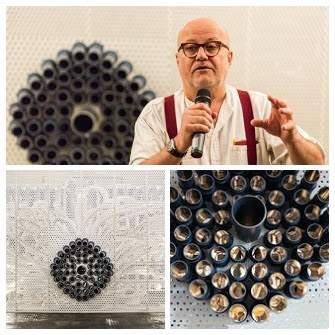
Now, fast-forwarding, more than 100 years later, Hartmann would have been astonished to witness the Smeller 2.0 at Berlin’s Martin-Gropius Bau museum. This temporary installation of a machine that pumps smells one after another into a room, was debuted in 2012 and has since been exhibited in different venues.  Wolfgang Georgsdorf, the artist, wants us to think about smell as an artistic experience and invented a machine called the Smeller 2.0. Closely resembling a pipe organ with its tangle of pipes and vents, it is the size of a small coffee shop, like a huge air conditioning unit. Its 64 chambers can each be loaded with a different scent, which can then be played like a musical note by the artist using a midi keyboard and digital-to-analog converters to turn electrical impulses into physical movements in the instrument.

According to other artists in the smell art community, the Smeller does what no one else in the intervening time period has ever managed to do: it pumps a series of defined, distinct smells into the room, one after the next. There are no sounds and no visuals. The scents dissipate just as the next one arrives, every inhalation a new surprise, it could be horse or a strong cheese. Georgsdorf, has spent more than 20 years getting his Smeller in front of an odience, which is what he calls those who experience it. He made the first prototype in 1996, but the idea has been in his head for almost his entire life. His first notable olfactory experiences as a child of four or five.

Georgsdorf researched into the previous attempts at creating a kinetic smell instrument. “What I saw was a series of very entertaining, triumphant failures,” he said. Sadakichi Hartmann’s electric fan was only the beginning of the 20th century’s experiments in olfactory performance. In 1906, before movie theatres even began to use sound, a newsreel of the annual Rose Parade in Pasadena, was shown in a theatre in Pennsylvania, with electric fans blowing the scent of the flower through huge cotton pads into the audience. There were several further efforts to pump different scents into theatres to correspond with a movie’s plot. The most famous example of this cinema-olfaction hybrid was Hans Laube’s Smell-O-Vision, which debuted with the film The Scent of Mystery in 1960. In specially-equipped theatres, 30 different odours were dispersed from audience members’ seats when triggered by the reel. Shortly before a similar technology, Aromarama, which used a cinema’s air conditioning system to diffuse odours into a theatre, was introduced. Neither one was successful. The New York Times called Aromarama a stunt and its odour sequences elusive.

More pungent neologisms followed: John Waters film Polyester in 1981 came with a scratch and sniff card entitled Odorama, containing scents like air freshener, skunk and pizza, that corresponded to numbers flashed on screen. Later copied by Nickelodeon under the moniker Aromascope. In 1999, the iSmell, a kind of shark-fin shaped USB drive with an air freshener attached, tried to offer consumers scents triggered by their internet browsers. Despite heavy investment, once more, these were to fail.

Georgsdorf comments that:

People have misunderstood on a physical level, a chemical level, on a perceptive level, and on a psychological level. The comparison with visual and audio performance has caused confusion. We are talking here about a new form of art that does not deal with waves such as light and sound, but with particles, and particles, unlike waves, don’t just cease to exist when a stimulus stops producing them. They linger.

The key question is, how does this relate to Art? Scientists are still figuring out the intricacies of how our brains decipher scents.  However, evidence suggests that the olfactory data is more deeply connected with memories than language, so is much more emotional. This makes scents difficult to talk about. We most often talk about the source of the smell, rather than the smell itself: something might smell like the pages of an old book for example. Scientists and artists have much in common, and perfumers are a mix of both.

He acknowledges that some of the difficulty lies in the artform itself. “We have 4,000 years of music history and we have zero thousand years of Osmodrama history, the vision is a new form of art that had never existed because simply the technology was not there”

For now, Georgsdorf has resisted mass-market ambitions. He seemed particularly irritated by the “wishful thinking” of the failed iSmell. But his work isn’t only about making smells into art. He is currently working on research with the University of Dresden and University Hospital in Berlin to test whether subjects with depression see an improvement in their symptoms after experiencing the distinct series of scents from the Smeller. Preliminary results suggest they do.

It’s not a gimmick, what started as a wacky experiment many years ago has been turned into a successful art installation. In the future it may feature more widely in our life’s. I am very interested to see where this leads, as many of the everyday items we use today would have been unimaginable to our ancestors. Some time in the future we could even have a home version of the Smeller!

The Great British Bake-Off

I heard some great news today. On Tuesday the 22nd of September its the return of the Great British Bake-off, complete with a new line-up. The wonderful Sandi Toksvig (like the equally wonderful Mary Berry) will be sadly missed. I am not a fan of reality TV, but once in a while something slips through the rubbish that is actually worth watching like; The British Sewing Bee, Painter of the Year and The Great British Bake- off. Anything that shows you a new skill is always good to watch and talk about!

Home- baking featured heavily in Lock-down 2020, flour was like gold dust as baking was seen as a great way of passing the time. Children learnt to bake with their parents, as I did as a child. The extra pounds gained from eating all these lovely sugar-filled treats was not so good. Now we are all have to eat less and exercise more to get back in shape, but it was worth it. My niece loves baking but takes what she makes into her workplace rather than eating it herself, much kinder to her waistline. Making her very popular with her colleagues too.

Before the Great British Bake-Off came to our screens. Home- Baking was seen as the domain of the WI, garden fetes and Grand-mothers. Now it’s for everyone and the marketplace is full of trendy, creative, youthful bakers, male and female. Even Waterstones has shelves full of baking books.

First aired on BBC Two on the 17th of August 2010, GBBO as it’s known as was an instant hit. I’ve become completely addicted. Whether it’s learning about the intricacies of the perfect pie crust, obsessing about soggy bottoms or lusting after the delicious cakes.

If you haven’t come across it before; the general idea is that ten home bakers take part in a bake-off to test every aspect of their skills as they battle to be crowned the Great British Bake Off’s best amateur baker. The series follows the trials and tribulations of the competitors, young and old, from every background and corner of Britain. They’re home cooks with a sense of humility and fun making them very likeable and watchable. Many past contestants have gone on to appear on their own series and produce books. Each week the bakers tackle a different baking skill. Cake-baking, pastry, bread-making and patisserie skills are all shown, ending with a showstopper which is the most creative. The tasks becoming progressively more difficult. Sometimes the results are successful and at times a total disaster. With lots of laughter and tears along the way. In a world where everyone wanting to be the best, it’s refreshing to see a group of people who genuinely cheer each other on. There’s a real sense of community and friendship, that does not feel forced. The spirit of kindness and niceness runs through the program. It’s no small thing in today’s world to be kind. But if a bunch of home bakers can bond over biscuits, it makes me feel like perhaps the rest of us can show a bit more kindness too.

It’s almost echoing back to a different era of tea parties, picnics and nostalgic Britain. Aprons, bunting and marques have all had a fashionable comeback. Home- made is seen as special and not more inferior than shop bought. Even the pretty hand-draw pictures that are used on GBBO have a special, unique character. I think that its a good thing to be nostalgic at times, particularly in such an era of uncertainty, anxiety and upheaval. Anything that makes you smile or reminisce about easier times can be uplifting. It’s not about looking backwards rather than forwards, but maybe some accepts of the past are worth returning to; making more ourselves, been happier with less, community, finding pleasure in simple things and teaching our younger generation to be able to make things etc. As I mentioned in my previous blog, statistics have shown we are less content now than in the 1950’s. It’s unrealistic to go back 60 years, but surely its worth considering why these were happier times and what can we learn. So as to change for the better. Happy Baking.

Perfume as an Art Form-Escentric Molecules

As you may have realized I do prefer natural things where possible, but at the same time its only fair to keep an open mind to new creative developments. Many Perfumers have struggled with the IFRA (The International Fragrance Association) which has banned many common ingredients in perfumery. Which has brought new challenges to the industry when a material is forbidden or restricted, sometimes for good reasons like health issues. Unfortunately, the most interesting ones are being cut out, so alternatives are having to be found and often this means developing a replacement in a laboratory.

One of the most creative Perfumers around is Gaza Scohen, his company, Escentric Molecules celebrates perfumery as the art of chemistry. It was in London, in 2006, that he launched Escentric Molecules, often described as the ‘anti-fragrance fragrance brand’. He started this as a niche brand never really thinking that this revolutionary fragrance would become so successful. Confounding his expectations to become a huge success.

What is it exactly? An aroma- molecule is something that does not exist in nature. Unknown outside the world of perfumery, (until the launch of Escentric Molecules) Iso E Super was created in a laboratory at IFF in 1973. It had been used in relatively low concentrations in the background of many fragrances for both men and women. Among perfumers, it is prized for its velvety, cocooning effect.

I realised that the common denominator in all the fragrances I liked was that they contained a large dose of it. Iso E Super is highly unusual. You can never get enough of it, it’s like a drug – Geza Schoen

After perfumer Geza Schoen first smelt Iso E Super, he began to experiment, creating fragrances that contained Iso E Super in unheard-of proportions even spraying nothing but the aroma-molecule itself. The molecules hover close to the skin so perfumes bond with the receptors in the olfactory system. The effects were immediate and he decided to create two fragrances which were radically minimalist. The fragrances are presented in binary pairs. Each pair explores one aroma-molecule in two different ways. One fragrance would contain an unprecedented 65% of the molecule. The rest of the formula would consist of ingredients designed to underscore its low-lit mood. This was a brave move; the second fragrance was totally non-conformist. It would contain only the molecule Iso E Super.

“I thought, this one will appeal only to the artists, the freaks, the outsiders.”

From its launch in 2006, Escentric Molecules was a phenomenon hit. Schoen followed the first pair of fragrances, 01, with 02, 03, 04, and in 2020, a fifth pair, Escentric Molecules 05. Each pair focuses on those rare aroma-molecules that have the radiance and depth of character to stand alone. The Escentric and Molecule fragrances in each series are sold separately. These don’t come cheap. But the fragrance smells different on every wearer, so it is cheaper than a bespoke scent.

Throughout his career Schoen has collaborated on conceptual projects such as Paper Passion, a fragrance with Steidl, Wallpaper and Karl Lagerfeld and worked with artists such as Wolfgang Georgsdorf, for whom he made 64 odours for Smeller, an olfactory organ that spectators can play like a piano to make aromascapes. Artist Wolfgang Georgsdorf wants us to think about smell as an artistic experience. (I will feature this in a separate post)

Geza Schoen, appears to be a reserved, modest man. He thinks a woman ‘s mind is sexier than her looks, values the dying art of face to face communication, has a deep-rooted love of natural ingredients and thinks most new “niche” perfumes are silly. I couldn’t agree more. He has brought something very different to an industry over-filled with much of the same. Not everyone wants to smell the same as everyone else. What he is creating is futuristic perfumery. It will be interesting to see if other companies follow his lead and how the coming decades with the rising costs and scarcity of natural ingredients will force more perfume houses into laboratories. As a perfumer he is both an artist and skilled craftsman. It would appear that perfumery is a combination of both skill and intuition. I am curious to see what he does next…..

Post- Coronavirus Consumerism

Now as a retailer, consumerism keeps me in work. Whilst, I think that quite a lot has been wrong on the high street for some time its important to still have a high street, for numerous reasons.

It has been estimated the country will have a £337 billion deceit this year. Which is 6 times more than the chancellor predicted in March. The majority of our economy is created by people spending money. Which is something until recently we have all been doing a lot, myself included. Children had to have the latest trainers, we all had to update our phones for the newer version. I had been having difficulties with my phone when I returned to the large phone company, I had purchased it from they told me my four-month-old Samsung phone was old, so it was not surprising it didn’t work. When did items still under guarantee become old? Years ago, you bought when you needed to replace an item that no longer worked not because you had to have the latest version.

We have been spending more for lots of reasons, but rarely because we actually needed something. Often, we buy clothing or goods that are “just okay” for no reason at all. Instant gratification and items buying for the sake of was the normal. Our ancestors saved up to buy and valued for many years the items they bought. I am sure they would be amazed by modern consumerism.

However, times are changing: job uncertainly, lose of earning, fear and caution have changed the high street. Some shops on opening, post-lock down had a flood of returning customers but many didn’t and the rush didn’t last long. A recent Instagram poll suggests that 67% of consumers are shopping less on the high street. On-line business had increased, but many companies had problems delivering and fulfilling the larger quantity of orders. So, buying online is not proving to be a 100% successful.

Now our spending was curtailed for several months, when shops, restaurants and pubs closed their doors temporarily. We couldn’t go out to shop, now shops have re-opened with restrictions in place, its not quite the same. Garments can’t be tried on; browsing is unfair when there is a queue outside waiting to come in. Prices in some cases have been slashed but in some sectors of the high street prices have risen. I think people have fallen out of love with shopping a little, having realised they didn’t actually miss shopping on the high street. Retailers will have to be inventive to coax shoppers back.

The larger high-street stores have been selling goods for less and less, usually by using 3rd world labour. But we are becoming aware of the human costs of having cheap clothes and the huge problem of land- fill with all our unwanted goods. Its been too easy to buy three items rather than just one. We have become a throw-away society. How we still consume but consider these factors is an important question.

In the 1950’s when we consumed less people were happier, so spending more didn’t make us happy. The lock-down was a wake- up call for us. Many big names are disappearing from the high street, although I would say that most of these were no surprise as problems had existed pre-lock down. Its awful that many people are losing their jobs and many more will most likely follow as businesses come out of furlough. The High street stopped listening to its customers a long time ago. Companies like Marks and Spencer’s have stopped making popular items to try to appeal to trendy, young customers disregarding the needs of their actual customers and wonder why profits are down! I hope than common -sense will out and they start making the right decisions.

I have always been a fan of smaller independent businesses; trade has been challenging for them. The constant price cuts and permanent sales have made it difficult to compete on a level playing field, with the high street. But customer service, passion, commitment and giving extra to their customers is what retail in the 2020’s should be about. These businesses implement customer- led changes quickly and are aware of packaging and the issues of sustainability. They may just be able to save the high street for us all.